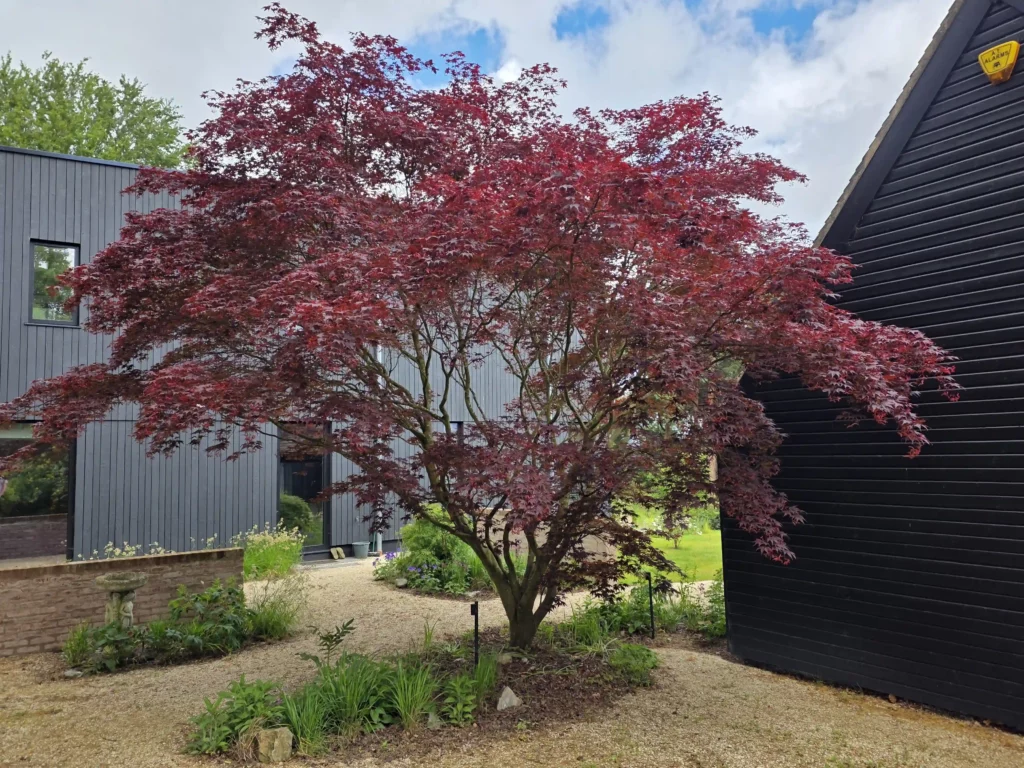
Care guide for trees & shrubs

This guide will explain how to get your new trees and shrubs established, and through the first three years when their need for supplementary water will be greatest. This guide goes hand in hand with our bespoke plant maintenance schedules that we provide.

Remember that a tree is a living thing and will give you signs to tell you what it needs, such as wilting leaves or early leaf fall in autumn often being a sign of a lack of water. Different sites will have soils that hold water and nutrients differently, so ensure you discuss with us what your soil is like and how quickly it drains to ensure that you can understand exactly how to care for your new trees & shrubs.

Watering of newly planted trees

  • A newly planted tree should be watered when it is planted, and then continuously through the season finishing only when the leaves have fallen in autumn. If the tree is planted during winter, then watering should start at the point of bud burst (the crucial spring stage when a plant’s winter dormancy ends, swollen buds open, and new leaves or shoots emerge). 
  • Use a watering can with a rose attachment, or a hose on ‘spray’ setting. This is important to avoid compacting the soil around the top of the root-ball, and to avoid exposing fine roots by removing the topsoil around them through powerful water jets.
  • Water should be evenly applied across the root-ball to encourage even root development, and to ensure one side of the root-ball doesn’t dry out.
  • After planting continue to water regularly for the first two summers. By the third year after planting the tree can access water from the surrounding soil on it’s own. During spells of extreme drought the tree may still need some supplementary water, so keep an eye on it if the leaves start to wilt.
  • Evergreen trees continue to take up water in the winter, and if there is a rare dry spell through winter then a little water will be required. Deciduous trees have no watering requirement while they are dormant in winter.
  • During the height of summer, water should be applied at a rate of 20 litres of water every other day.  This figure is the aim to reach during the height of summer and can be gradually increased to this in the spring and decreased before ceasing watering in the autumn.
  • This figure is dependant on conditions, in a heat wave or on a particularly windy site trees could require even more water than this, so the 20 litre figure should be treated as a guide with some flexibility.
  • Just because it’s been raining doesn’t mean your newly planted tree has had enough water. Rain often doesn’t reach the root ball directly, especially if the tree has a wide canopy. Continue to water the base even after light rain.
  • If you are unsure about if a tree needs more water then it can be inspected by hand. Gently move a small amount of soil to one side by hand and push your finger into the soil to feel if the soil is dry, slightly damp or soggy. You want the soil to feel evenly moist, rather than completely saturated with water. One year may be a particularly cool wet summer, while the next may be an unusually dry summer with days that regularly exceed 25-30c. The watering requirements will differ in each of these years.
  • If you have had a larger tree planted that includes a perforated irrigation pipe installed around the root-ball, finish the watering by delivering a few short bursts of water into this pipe using a hose.  This will deliver water to the deeper root zone. It is very important not to leave the hosepipe running in this pipe as this can cause the surrounding soil to completely saturate. If the water backflows through the pipe or does not drain freely out of it then do not use it for watering, the ground conditions may need to be checked for poor drainage or saturation.
  • As important as it is to keep your new trees properly watered, it is also possible to over water. One of the key signs of over watering is yellowing leaves that drop from the branches, which can also happen if the tree is under watered. If you see yellowing leaves, ensure that you check the moisture levels at the roots of the plant. If the tree has been regularly watered and the root-ball is soggy or saturated with water then this is a sure sign of overwatering. Leave the tree to dry out for a few days and see what the moisture levels are like at the root-ball before adjusting your watering regime.
 

Fertilising newly planted trees

  • Provided they have been planted in a good quality soil, most trees will enjoy good health and make satisfactory growth without the need to fertilise. This is not to say that a healthy tree wouldn’t enjoy an annual top-dress of fertiliser if it was offered, especially a good autumn feed with high potassium. Top-dress slow-release fertilisers formulated specifically for trees and shrubs are easy to apply and available from most garden centres. Be sure to follow instructions carefully as dosages vary among products, and using too much fertiliser can cause chemical burns to plants.
  • If you use a ‘weed and feed’ product on your lawn, ensure that this isn’t used anywhere near the roots of trees as ‘weed and feed’ products contain herbicides that target broadleaf plants. These herbicides will target trees whose roots extend into a lawn, especially if applied incorrectly.
  • Slow release granular fertilisers can be toxic to animals and pets in large quantities, so check this before applying a surface level top-dress.
 

Watering newly planted shrubs

  • Avoid a routine such as “watering once a week”. Shrubs need different amounts depending on the variety, weather, soil type, stage of establishment and size. In their first year, water around the base of the plant until the soil is evenly moist down to the depth of the roots – typically 30cm. Avoid watering the foliage as this water will just evaporate off and not be absorbed and used by the plant.
  • Use a watering can with a rose attachment, or a hose on ‘spray’ setting. This is important to avoid compacting the soil around plants, and to avoid exposing fine roots by removing the topsoil around them by using powerful water jets.
  • After the first year watering can be reduced but keep an eye on the shrubs for signs of wilting, leaf scorch or reduced growth / flowering as these can all be signs of a lack of water. Shrubs will still be vulnerable to droughts as they get established through their second and third years so ensure they remain watered regularly through hot dry spells. This is more important with shrubs that have been planted at a larger size.
  • Evergreens can be trickier to manage as they tend not to show the same signs of water stress as deciduous shrubs, and once an evergreen shrub shows signs of unhappiness it is often too late to recover. Ensure that you check the moisture level around the roots by pulling a small amount of soil back from the root zone and pish your finger in to check if the soil feels dry, moist or saturated with water. You are ideally looking for an even level of moisture at the roots of these plants.
  • Evergreen shrubs continue to take up water in the winter, and if there is a rare dry spell through winter then a little water will be required.
 

Fertilising newly planted shrubs

  • Provided they have been planted in a good quality soil, most shrubs will enjoy good health and make satisfactory growth without the need to fertilise. This is not to say that a healthy shrub wouldn’t enjoy an annual top-dress of fertiliser if it was offered, especially a good autumn feed with high potassium. Top-dress slow-release fertilisers formulated specifically for trees and shrubs are easy to apply and available from most garden centres. Be sure to follow instructions carefully as dosages vary among products, and using too much fertiliser can cause chemical burns to plants.
  • If you use a ‘weed and feed’ product on your lawn, ensure that this isn’t used anywhere near the roots of shrubs as ‘weed and feed’ products contain herbicides that target broadleaf plants. These herbicides will target trees whose roots extend into a lawn, especially if applied incorrectly.
 

General care of trees & shrubs

  • Ensure that any weeds that grow around the base of trees and shrubs are carefully removed by hand, this is much easier when they are small and just emerging.
  • A good fine mulch at a depth of 50mm at the base of trees and shrubs is usually recommended, this can help to preserve moisture in the soil and reduce the number of weeds growing in the soil around them.
  • If a mulch is applied at a tree base ensure that none of it is mounded up around the base of the tree as this can cause wet mulch to sit in contact with the trunk, causing it to rot and death to the tree. Always leave a space of around 50 – 75m around the base of the tree trunk clear of mulch.
  • Ensure that the planting area is kept well weeded as weeds compete with your plants for light, water and nutrients. Weeds can also smother newly planted ornamentals causing them to die off or perform sub optimally due to competition. It is important to quickly learn what is a weed and what is a desirable plant to keep in the garden.

Midlands office:

Navigation House
Newark
NG24 4TS
Tel: 01636 870 057

London office:

Percy Street
London
W1T 1DR
Tel: 0207 125 0264

info@aptstudios.co.uk